
TR to PR 2026 - Not What We Expected: The Truth About IRCC’s 33,000 "TR to PR" Announcement

Updated: May 5
If you’ve been frantically searching for updates on the new “TR to PR” pathway for 2026, you are not alone. For months, temporary workers across Canada have been waiting for
Immigration, Refugees and Citizenship Canada (IRCC) to open a massive new public pathway similar to the historic program we saw in 2021. Today, IRCC finally released the official backgrounder for this policy officially named the In-Canada Workers Initiative and for many hopeful applicants, it feels like a massive letdown.
In short: This is not a new, open-to-everyone TR to PR pathway.
Instead of creating a fresh opportunity for temporary workers and international graduates, the government is simply accelerating the processing of existing applications for people in very specific regional and occupation-driven pilots. Here is the reality of what the 2026 TR to PR announcement actually means, who qualifies, and why the government's communication has left so many feeling betrayed.
Want to skip the confusion and find out exactly what your PR options are?

1. Who is Actually Eligible in TR to PR? (The Reality Check)
The phrase "TR to PR" made many believe they could submit a brand-new application. However, the In-Canada Workers Initiative is strictly focused on clearing existing inventories of people who have already applied or been selected through targeted regional streams.
According to today’s official IRCC Backgrounder, the 33,000 spots for 2026 and 2027 are being dedicated to accelerating applications in the following existing programs:
Provincial Nominee Programs (PNPs): Accelerating existing files for those nominated by provinces and territories.
The Atlantic Immigration Program (AIP): For skilled workers and graduates already living and working in the four Atlantic provinces.
Community Immigration Pilots: Focusing on the 18 selected rural and northern communities.
The Caregiver Pilots: For qualified home child care and home support workers whose applications are already in the system.
The Agri-Food Pilot: Accelerating applications accepted before May 14, 2025.
If you are not already in one of these specific pipelines, this initiative does not provide a new way for you to apply for Permanent Residence.
2. The Major City Exclusion: Who is Locked Out
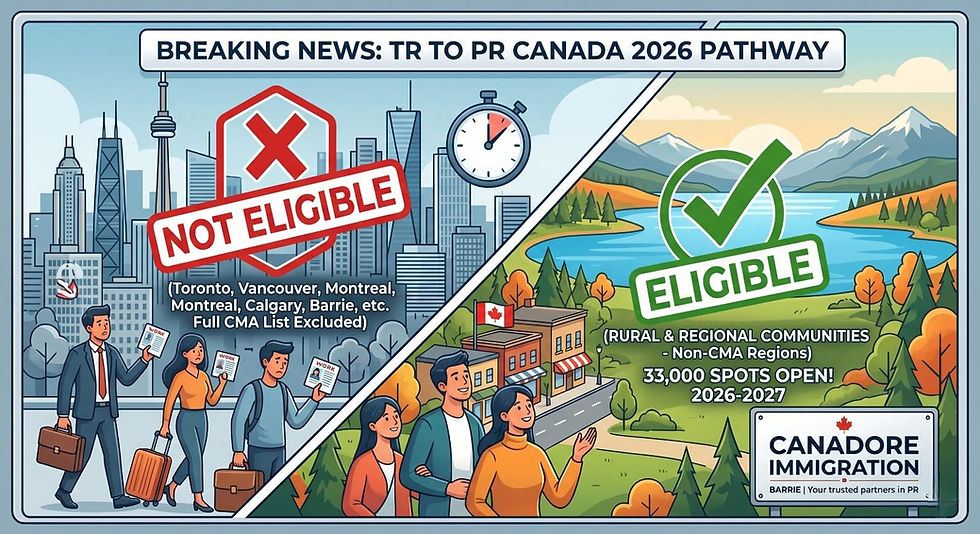
Perhaps the biggest blow to applicants was the quiet confirmation that workers in major urban centers are completely excluded from this priority processing. To qualify under the rural/regional targets of this initiative, you cannot live in a Census Metropolitan Area (CMA). There are 41 CMAs in Canada, covering about 84% of the population.
Not sure if your city is on the list? Check out our complete list of all 41 excluded CMAs in Canada.
Living in an excluded city? Don't lose hope. There are still Express Entry and Provincial Nominee options available.
3. Why It Feels Like a "Hoax"
If you feel like you were misled by the government, your frustration is completely justified. The communication rollout for this policy was a textbook example of what not to do.
In early March, Immigration Minister Lena Diab caused widespread panic and false hope by telling the media that a 33,000-spot TR to PR pathway had "already launched quietly," without providing any eligibility criteria. Desperate applicants began paying unauthorized "consultants" to get on fake waitlists for a program that didn't exist in the way they imagined. It wasn't until a podcast interview in late April that the Minister casually mentioned the exclusion of all 41 major cities.
Giving people in major cities false hope for over a month, only to pull the rug out from under them, has caused massive anxiety. As licensed immigration consultant at Canadore Immigration in Barrie, we believe in giving you the honest facts, not false hope."
.
4. What Should You Do Now?
The 2026 TR to PR pathway might not be the miracle solution you were hoping for, but that does not mean you are out of options.
If you live in a rural area: Check to see if your current job or application aligns with the targeted regional pilots (like the AIP or Community Pilots). We can help ensure your file is flawless so it can be accelerated under this initiative.
If you live in a major city (CMA): Do not wait around for IRCC to change their minds. You need to pivot your strategy immediately. We need to look at maximizing your Comprehensive Ranking System (CRS) score for Express Entry, exploring employer-
driven Provincial Nominee Programs (PNPs), or finding specialized targeted draws.
Frequently Asked Questions (FAQs) About the 2026 TR to PR Update
Is there a new, open TR to PR pathway for 2026?
No. The government’s new "In-Canada Workers Initiative" is not a new public pathway like the one we saw in 2021. It is a targeted policy designed to accelerate the processing of applications that are already in the system under specific regional and occupation-driven pilots.
I live in Toronto/Vancouver/Calgary. Do I qualify for the new TR to PR update?
Unfortunately, no. A major requirement for this initiative is that it focuses on rural and smaller communities. Anyone living or working in one of Canada's 41 Census Metropolitan Areas (CMAs) which includes all major cities is excluded from this priority processing. Check out our complete list of all 41 excluded CMAs in Canada.
Which immigration programs are included in the In-Canada Workers Initiative?
IRCC is only accelerating existing applications for the Provincial Nominee Program (PNP), the Atlantic Immigration Program (AIP), the Rural and Northern Immigration Pilot (RNIP), the Caregiver Pilots, and the Agri-Food Pilot.
What should I do if I don't qualify for the In-Canada Workers Initiative?
Do not wait for a new TR to PR program to be announced. If you are excluded from this initiative, you need to immediately look at improving your Express Entry Comprehensive Ranking System (CRS) score, finding an employer-driven Provincial Nominee Program (PNP), or exploring targeted draws. Book a consultation with us to find your best alternative route.
How many candidates have been approved so far?
Between January 1 and February 28, 2026, IRCC approved permanent residence for 3,600 workers through the initiative, representing 18% of its 2026 target.
Waiting for a miracle pathway is no longer a viable strategy. Stop guessing and let the RCIC experts at Canadore Immigration in Barrie build a permanent residence plan based on facts.


Comments