
TR to PR 2026 : Major Cities Excluded – What You Need to Know

Updated: May 4
OFFICIAL TR TO PR UPDATE - May 4, 2026: IRCC has just released the official written policy for the In-Canada Workers Initiative. Not only does it officially confirm the exclusion of the 41 CMAs listed below, but it also heavily restricts which programs and applicants actually qualify. Read our complete breakdown of the new official eligibility rules to see if you have a pathway forward or need a new strategy.
If you are a temporary foreign worker in Canada, you are likely feeling the immense pressure of the government's push to reduce the temporary resident population to under 5% by 2027. We hear your anxiety, and it is completely valid. The rules of the game are changing rapidly, and staying informed is your best defense.
Earlier this year, Immigration Minister Lena Metlege Diab confirmed a highly anticipated new Temporary Resident to Permanent Resident (TR to PR) pathway capped at 33,000 spots for 2026 and 2027. However, a breaking announcement on April 18, 2026, has fundamentally shifted who will be eligible for this program.
In a follow-up interview on April 18, 2026,Minister Diab provided critical new clarity on how the 33,000 spots will be allocated. While the program’s soft-launch was first mentioned in March, the Minister has now confirmed a "Regional-First" approach prioritizing applicants who are established outside of Canada's major urban centers.
At Canadore Immigration in Barrie, Ontario, led by Surjeet Singh (RCIC-IRB), we are dissecting these new rules to give you the honest, factual guidance you need. Here is a comprehensive breakdown of the updated 2026 TR to PR pathway and what you must do right now if your city was just excluded.
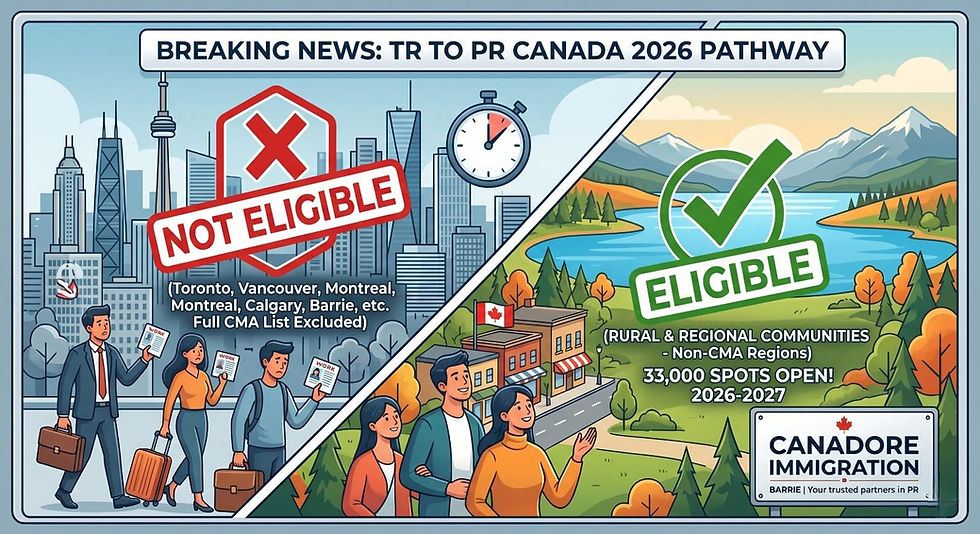
The Big Update: Major Cities (CMAs) Are Excluded
In a significant pivot, Minister Diab announced that the new TR to PR program will exclude all Census Metropolitan Areas (CMAs). This program is strictly doubling down on retaining workers in rural and smaller communities.
What is a CMA?
Statistics Canada defines a CMA as an urban core with a total population of at least 100,000 (where at least 50,000 live in the core). Canada currently has 41 CMAs, housing roughly 84% of the population.
If you live and work in any of the following major hubs, you will not be eligible for this specific TR to PR pathway.
The Official List of CMAs (By Province)
Ontario (15)
Barrie (Yes, our home base is officially a CMA)
Belleville
Brantford
Greater Sudbury
Guelph
Hamilton
Kingston
Kitchener–Cambridge–Waterloo
London
Oshawa
Peterborough
St. Catharines–Niagara
Thunder Bay
Toronto (including the entire GTA)
Windsor
British Columbia (7)
Abbotsford–Mission
Chilliwack
Kamloops
Kelowna
Nanaimo
Vancouver
Victoria
Quebec (6)
Drummondville
Montreal
Quebec City
Saguenay
Sherbrooke
Trois-Rivières
Alberta (4)
Calgary
Edmonton
Lethbridge
Red Deer
New Brunswick (3)
Fredericton
Moncton
Saint John
Saskatchewan (2)
Regina
Saskatoon
Manitoba (1)
Winnipeg
Nova Scotia (1)
Halifax
Newfoundland and Labrador (1)
St. John's
Cross-Border / Multi-Province (1)
Ottawa–Gatineau (Spans Ontario and Quebec)
What Does This Mean for You?
We believe in candid advice: if your home or workplace is within the boundaries of the cities listed above, this specific door has closed. However, your PR journey is not over.
1. For Those Living Outside CMAs
If you live in rural Ontario, smaller townships, or communities outside of the 41 CMA boundaries, you are in a prime position. Competition for the 33,000 spots will be fierce, so you must prepare immediately.
2. For Those Living Inside CMAs
If you are excluded from the TR to PR program, you must aggressively pursue alternative pathways.
Maximize Express Entry: Work on boosting your Comprehensive Ranking System (CRS) score. Retake your language tests (aiming for CLB 9+), gain more skilled work experience, or learn French to qualify for category-based draws.
Provincial Nominee Programs (PNPs): Programs like the Ontario Immigrant Nominee Program (OINP) still actively recruit workers in major hubs, particularly in healthcare, tech, and skilled trades.
Feature | TR to PR Pathway 2026 | Express Entry / PNPs |
Location | Strictly Non-CMA (Rural/Small communities) | Open to all regions (including Toronto, Barrie, etc.) |
Availability | Limited to 33,000 spots (2026–2027) | Continuous, year-round draws |
Language Needs | Expected lower threshold (CLB 4+) | Typically higher (CLB 7+) depending on the stream |
Selection | First-to-qualify or sector-based | Competitive scoring (CRS or PNP matrix) |
Anticipated Eligibility for the 2026 TR to PR Pathway
For those in qualifying non-CMA regions, IRCC is expected to release the final program guide by the end of April 2026. Based on current government signals, applicants will likely need:
Location: Proof of physical residence and employment strictly outside of any Canadian CMA.
In-Demand Sectors: Proof of current employment (and likely a minimum of one year of full-time Canadian experience) in critical industries like healthcare, skilled trades, agriculture, or food processing.
Valid Temporary Status: A valid Canadian work permit and compliance with conditions of stay.
Language Proficiency: A minimum Canadian Language Benchmark (CLB) score, likely around CLB 4.
How to Prepare NOW (Don't Wait for the Portal to Open)
If you are in a qualifying rural area, the applicants who succeed will be document-ready on day one. Take these steps immediately:
Book Your Language Test: Complete your IELTS General, CELPIP-General, or PTE Core.
Gather Employment Records: Request employer reference letters clearly stating your job duties, hours, salary, and dates of employment. Gather your T4s and pay stubs.
Request Police Certificates: Obtain certificates for any country you have lived in for six months or more since age 18.
Verify Your Geography: Double-check your exact home and work address against the Statistics Canada CMA map to ensure you are truly in an eligible rural zone.
Why Choose Canadore Immigration?
Navigating immigration policy shifts requires a cool head and strategic expertise. At Canadore Immigration, our President, Surjeet Singh (RCIC-IRB), has lived the immigrant experience. We provide empathy, rigorous honesty about your chances, and custom-tailored strategies.
Even if the new TR to PR program excludes your city, we can help you pivot to the OINP, Express Entry, or assess if relocating to a non-CMA region makes sense for your timeline. We offer consultations in English, Punjabi, and Hindi at our Barrie office.
Is the TR to PR Canada 2026 pathway open to applicants in Toronto, Vancouver or Barrie?
No. As of April 18, 2026, the Immigration Minister confirmed that the program strictly excludes anyone living and working in Canada's 41 Census Metropolitan Areas (CMAs), which includes Toronto, Vancouver, Montreal, Calgary, and Barrie
What is a CMA in Canada?
A Census Metropolitan Area (CMA) is defined by Statistics Canada as an urban core with a population of at least 100,000. Check the full list above—if your address falls within one of those boundaries, you are disqualified from the 2026 TR to PR pathway.
How many spots are available in the new program?
There is a strict cap of 33,000 permanent residence spots distributed over two years (2026–2027).
What should I do if I live in a CMA and my work permit is expiring?
Do not panic, but act quickly. Consult with a licensed immigration professional to explore alternatives like Express Entry, Provincial Nominee Programs (PNPs), employer-sponsored LMIAs, Francophone Mobility work permit or legally extending your temporary status as a visitor or student while you build a new strategy.
Don't let policy changes derail your Canadian dream.
Whether you need help applying for the rural TR to PR pathway or need a new strategy for the city, preparation is your best asset. Contact Canadore Immigration today to book your consultation. If you sign a retainer agreement within 14 days, your initial consultation fee will be fully credited toward your final retainer!


Comments